By Admin.
When one autistic woman posted about her changing feelings on marriage and kids — describing how her autism diagnosis had shifted her perspective on both — she got nearly 300 responses. The thread became one of the most honest, varied, and at times surprisingly funny conversations about life choices in the autism community.
Here’s what people actually said.
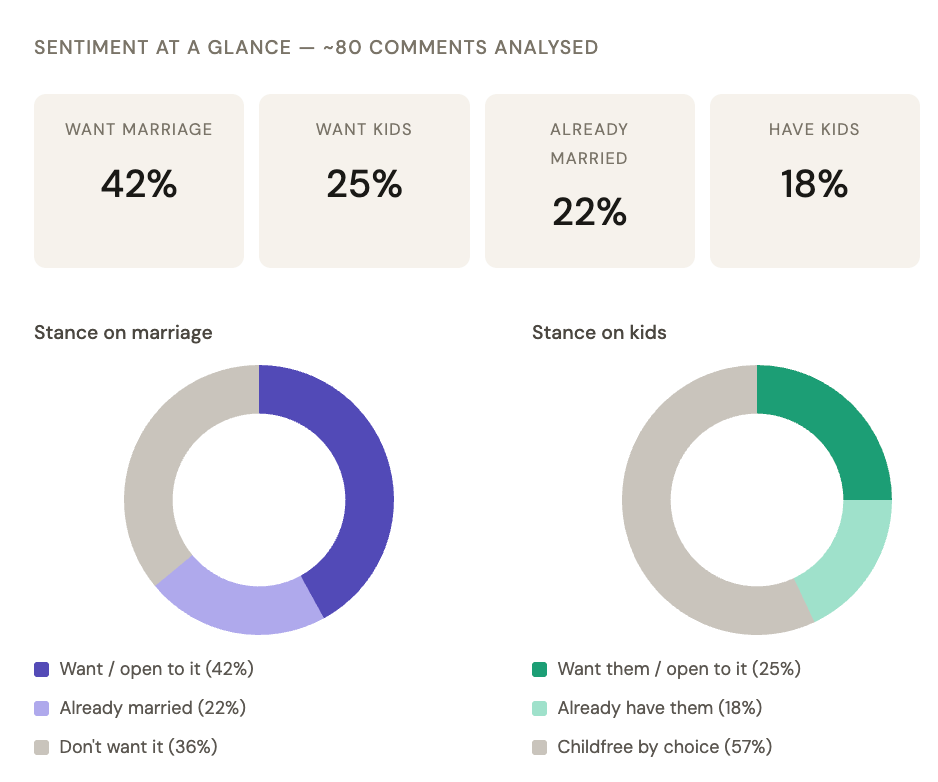
The majority lean childfree — but it’s complicated
The clearest takeaway: most commenters in this thread did not want children. But “don’t want kids” rarely came without nuance.
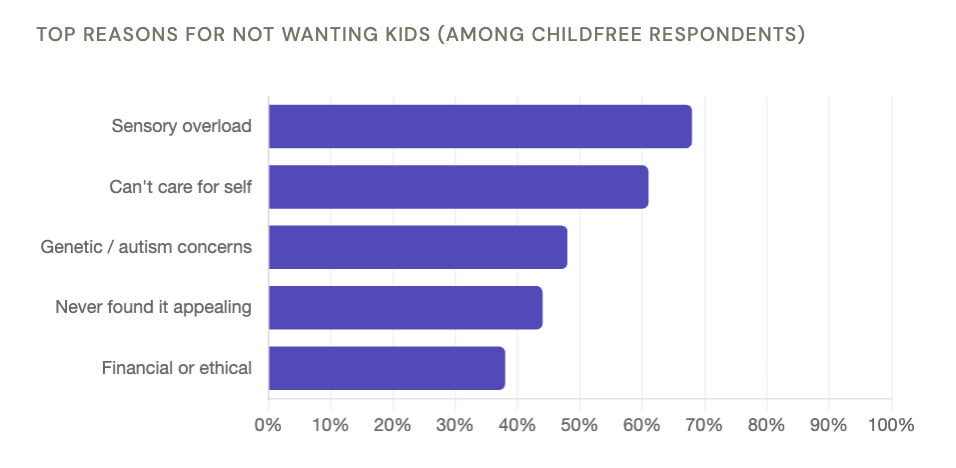
The most common reasons given were:
- Sensory overwhelm. Babies cry. Toddlers are loud, unpredictable, and sticky. For many autistic people whose nervous systems are already taxed, this isn’t abstract — it’s a dealbreaker. One person put it bluntly: “I’ve been to Walmart. I’m still sure I don’t want kids.”
- Struggling to care for themselves. “I can barely keep myself alive,” wrote one commenter. “Having a small human and a partner to deal with is way too much.” This came up again and again — not as self-pity, but as self-awareness.
- Genetic concerns. Many worried about passing autism on to a child and not having the bandwidth to support them.
- It was never the dream. For a surprising number of people, the desire for kids had simply never been there. Some had wanted it as children (following the “life script,” as one commenter called it), only to realize as adults that they’d internalized an expectation rather than a genuine wish.
- Ethical reasons. A vocal minority described antinatalist views — the belief that bringing a person into existence is itself a harm.
Marriage got a much more mixed reception
Feelings about marriage were more divided. Many people who wanted nothing to do with children were still open to — or actively wanted — a committed partnership. The sticking points were usually cohabitation, dependence, and traditional roles.
“If you love someone enough to think about marriage, you’re already married.”
Those who were married — and there were quite a few — often described it positively, especially when their partner was also neurodivergent or particularly understanding. One commenter described her husband stepping in on her worst burnout days to handle chores, walk the dog, and bring her safe foods.
The autistic parents who showed up
A notable group pushed back gently on the idea that autism makes parenting impossible. Several parents in the thread described finding it more manageable than they’d feared — particularly with young children.
“I thought the kid was the most perfect child on the planet because he actually made sense to me. Turns out that’s because the kid is autistic and so am I.”
Others noted that autistic parents often have specific advantages: rigid routines (which kids thrive on), heightened awareness of sensory needs, and a genuine interest in understanding rather than forcing conformity. The teens and adult-children years were flagged as harder.
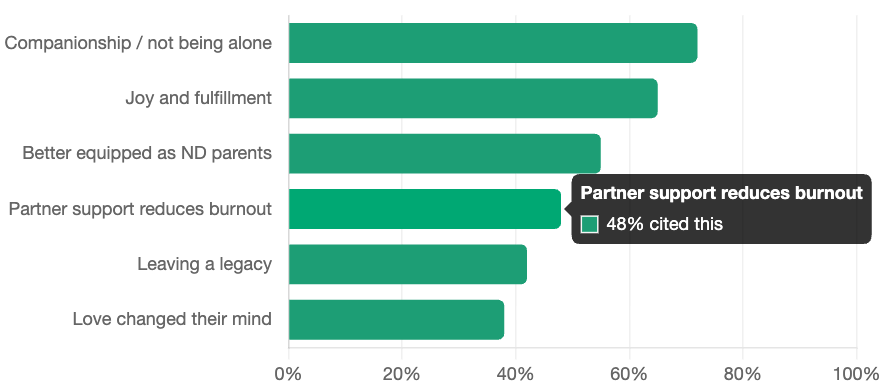
Those who did want kids — or already had them — cited a distinct set of motivations:
- Companionship and not being alone. Fear of loneliness, especially as parents age, was the most common driver. “Without them I would be very lonely,” wrote one married father, noting that his wife and kids were his deepest relationships by far.
- Joy and a sense of purpose. Multiple parents described parenthood as the most fulfilling thing they’d done — giving them a clear reason to push through hard days. “I have a clear purpose now: making sure my daughter is safe and happy.”
- Being uniquely equipped as ND parents. Several commenters felt their own autism was actually an advantage. Two ND parents raising an ND child would understand that child better than anyone — no one would need to explain sensory overwhelm or meltdowns.
- A good partner offsets burnout. Some who’d been on the fence found that the right relationship changed the equation entirely — a supportive partner sharing the load made the prospect feel manageable rather than crushing.
- Leaving something behind. A handful cited legacy — wanting to be part of something larger than themselves, or to give a child the love their own parents gave them.
- Love simply changed their mind. More than a few admitted they’d been firmly against kids until they met the right person. “I have fucking baby fever now,” wrote one commenter who’d previously felt certain.
The broader takeaway
What makes this thread worth reading isn’t that it reaches a conclusion — it doesn’t. It’s that it captures something rarely said openly: that the standard milestones of adult life don’t map neatly onto neurodivergent experience, and that’s not a deficit.
Whether commenters wanted marriage, kids, both, or neither, the most common note was some version of: figure out what you actually want, not what you’re supposed to want.
“Just trust yourself to know what’s best for you, but keep an open mind — present-day you is pretty bad at predicting what future you will want.”
That’s probably good advice for anyone.


Leave a Reply